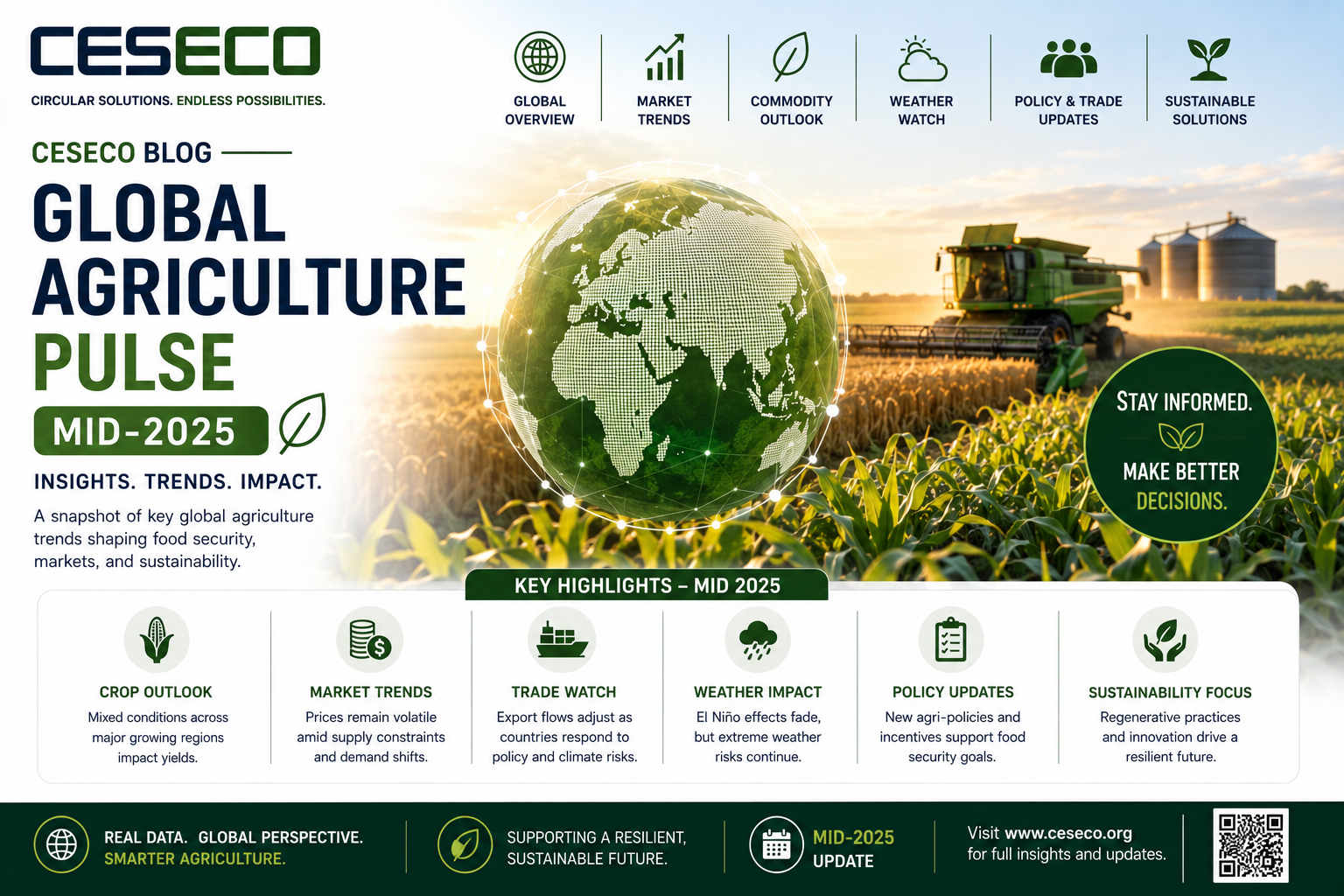
First Quarterly Edition · Insightful, evidence-led commentary from a British perspective with footprints in China, Australia and the UK.
- Price Environment — Headline Index Eases, But the Picture Is Mixed
- The FAO Food Price Index slipped for a second month, averaging 127.7 points in May 2025 (-0.8 % m-o-m), as cheaper cereals, sugar and vegetable oils outweighed firmer meat and dairy values. Although still 6 % higher than a year ago, the index sits a comfortable 20 % below its 2022 peak, confirming a gradual post-Covid, post-Ukraine recalibration.
- Grain markets remain well supplied. USDA’s June WASDE lifted global coarse-grain production for 2025/26 by a further 1.2 Mt to 1.551 Bt, thanks to near-record South-American maize crops and benign planting weather across the US corn belt.
Interpretation: input cost pressure for feed users is easing, but premiums for quality protein and dairy persist. Budget accordingly when negotiating forward supply contracts.
- Climate & Geopolitics — El Niño, Heat and Logistics
- The fading 2024/25 El Niño delivered welcomed precipitation to North America and parts of Australia, yet pushed global land temperatures to new highs. Researchers warn of heightened heat-stress episodes for crops in the Northern Hemisphere summer, posing a latent risk to late-season yields.
- Logistic pinch-points linger: low water on the Panama Canal and ongoing disruptions in the Black Sea keep freight premiums volatile, a point of concern for Australian grain exporters and Chinese soy importers alike.
- Investment & Technology — From ‘Growth at Any Cost’ to Disciplined Capital
- Ag-tech funding is in reset mode: global agrifood-tech VC deployment has fallen ~70 % from the 2021 peak, with 2025 indoor-farming deals totalling a modest $57 m after a string of high-profile bankruptcies. Investors are now demanding clear pathways to profitability and scalable energy footprints before signing cheques.
- Bright spots remain. AgFunder records $16 bn of funding in 2024, only 4 % shy of 2023, signalling selective support for robotics, biological crop protection and carbon-monitoring software.
Implication for CESECO: capital discipline favours businesses with tangible assets, proven routes to revenue and measurable ESG outcomes — precisely the territory our eco-park model occupies.
- Sustainability & Regeneration — Momentum Builds
- Corporate buyers and policymakers are stepping up regenerative agriculture commitments. The latest State of Agriculture Resilience survey reports that 64 % of multinationals now have an approved soil-health or carbon-farming roadmap, up from 41 % two years ago.
- Field data show farmers deploying regenerative practices are capturing 20–30 % higher profit margins versus conventional peers, driven by lower input spend and emerging carbon-credit revenue.
Take-away: regenerative supply chains are no longer niche; they are on the cusp of mainstream adoption. Early movers will secure premium contracts and potential policy incentives.
Closing Thought
Volatility remains the only constant in global agriculture, yet the trends towards cost-efficient production, climate resilience and data-backed transparency are unmistakable. CESECO is positioned at this nexus — delivering circular bio-solutions while supplying investors and partners with clear, data-driven intelligence.
Follow CESECO for monthly deep-dives and on-the-ground perspectives from our team in London.
sources and references:
- FAO, Food Price Index, May 2025. 2. USDA, World Agricultural Supply and Demand Estimates (WASDE), June 2025. 3. NOAA & Berkeley Earth, Global Temperature Update, May 2025. 4. Panama Canal Authority, Water Level Advisory, May–June 2025. 5. AgFunder, AgriFoodTech Investment Report 2024/25. 6. KPMG & Climate AI, State of Agriculture Resilience Survey 2025.
