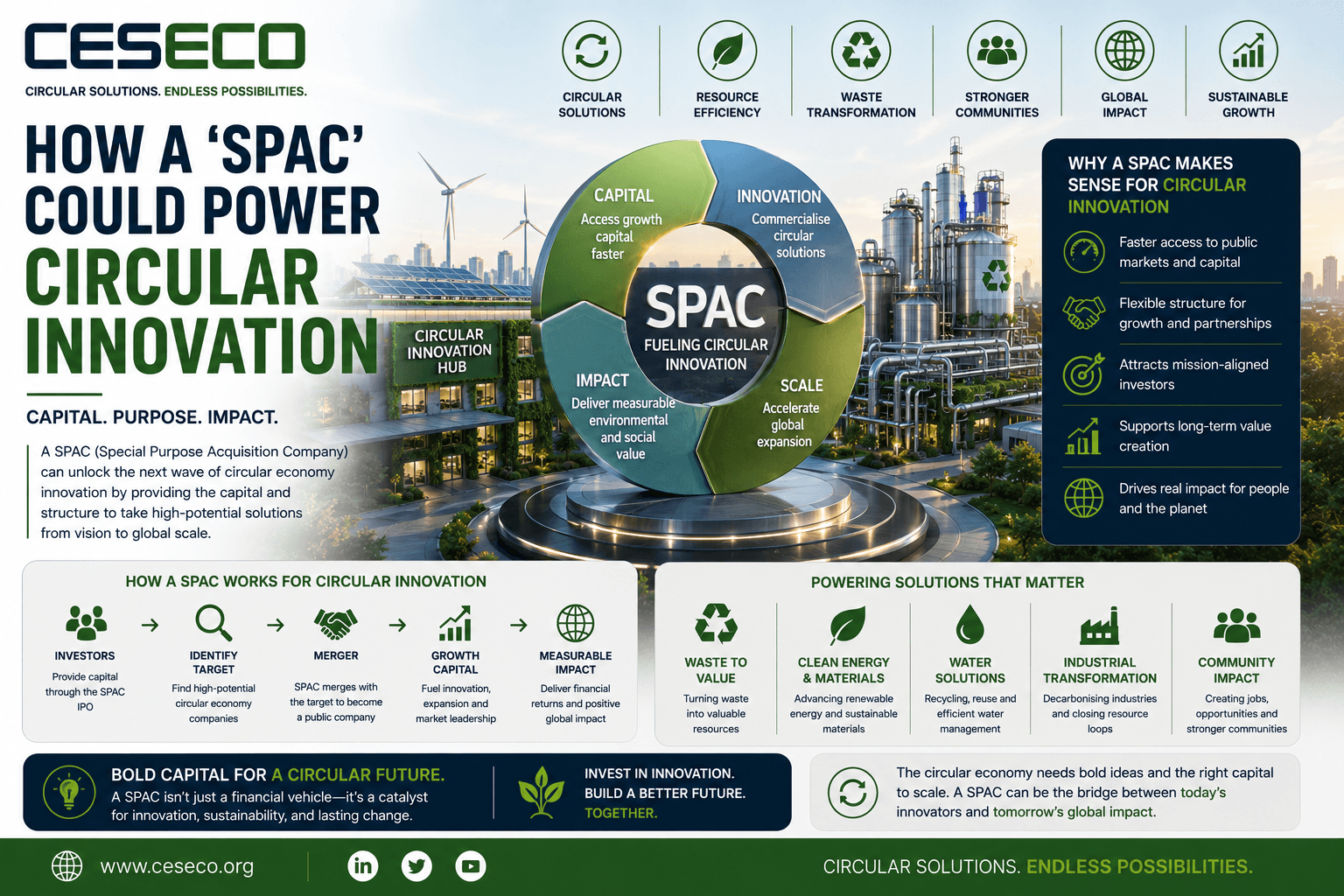
SPAC Financing & CESECO: How a SPAC Could Power Circular Innovation
CESECO is exploring the potential of SPAC financing—special-purpose acquisition companies—as a powerful avenue to accelerate our closed-loop, circular economy model globally. Here’s a streamlined overview of how a SPAC could support CESECO’s growth, the benefits and risks involved, and why it might be the right strategic move.
What Is a SPAC and Why CESECO Is Considering It
A SPAC, or special-purpose acquisition company, is a publicly traded shell company formed to raise capital through an IPO and later merge with a private firm, allowing that firm to go public more efficiently than via a traditional IPO. For CESECO merging with a SPAC could offer rapid access to public markets and capital tailored to fund large-scale eco‑park deployments in the UK, US, Australia, and beyond.
Why SPAC Financing Could Supercharge CESECO’s Expansion
Rapid Capital Injection
A SPAC merger can deliver a significant capital raise without the lengthy metrics scrutiny and regulatory steps of a standard IPO—enabling CESECO to power installations quickly and efficiently.
Public Market Exposure
Through a SPAC – CESECO would gain visibility with institutional and retail investors alike, building capital market credibility around our brand and mission.
Structured Strategic Support
Partnering with a SPAC sponsored by experienced teams—especially those focused on sustainability or agri-tech—could bring advisory support and networks for off‑take partnerships, supply contracts, and investment corridors.
Key Risks and Pitfalls to Navigate
Regulatory & Dilution Concerns
SPAC structures require clear disclosure of potential dilution and sponsor fees—as a significant portion of funds may go to underwriters and early backers, reducing operational capital.
Investor Performance Realities
Historical SPAC performance post-merger has often underperformed traditional IPOs, with average returns falling sharply in the year following the merger—making investor trust a critical challenge.
Market Volatility and Speculation
SPAC stocks can trade with high volatility, influenced more by speculative sentiment than long-term asset value—especially risky for a long-horizon environmental project like CESECO.
Compliance and Governance Complexity
Navigating governance, SEC filings, international vs. domestic public entity regulations—especially across UK, US, and Australia—requires expert legal support.
How CESECO Could Use a SPAC Responsibly
- Select a mission-aligned SPAC sponsor with experience in sustainable finance or green infrastructure.
- Define clear performance metrics: Energy production, CO₂ credits, fertiliser volumes, feed output, job creation—ensuring transparency for post‑merger reporting.
- Negotiate fair economics: Minimise sponsor dilution, manage lock-up periods intelligently, and protect public investors.
- Integrate ESG reporting into quarterly disclosures—reinforcing trust and impact accountability.
- Leverage public listing for strategic partnerships: With investors, governments, and off‑take networks across major markets.
SPACs Are Making a Comeback: What It Means for CESECO
SPAC activity is picking up pace again in 2025, with new filings for $50–$200 million SPACs focused on sectors including clean energy, fintech, and impact technology. This revival suggests a favourable moment for CESECO to structure a SPAC merger focused on circular innovation.
Why SPAC Financing Could Be a Game-Changer for CESECO
- Accelerates project deployment by unlocking swift capital.
- Delivers public market credibility for CESECO’s brand and operations.
- Enables structured ESG-linked funding, tied to measurable impact.
- Builds global exposure and inclusivity in funding—attracting institutional and retail investors aligned with sustainability.
Conclusion
If structured properly, SPAC financing offers CESECO a dynamic path to scale, supporting our mission to build high‑impact circular eco‑parks across markets while delivering measurable returns. We see SPACs not just as capital vehicles, but as strategic partners in scaling a circular economy future.
While the risks are real, they’re navigable with the right legal, governance, and investor frameworks—and with CESECO’s proven operations model, we’re poised to lead.
