Why England’s 2025 Waste-Separation Law Super-charges CESECO
From 31 March 2025 every business, charity and public-sector workplace in England— from cafés to factories—must separate food waste for collection alongside dry recyclables and residual waste. Micro-firms get a grace period to 2027, but everyone else is already on the hook. Non-compliance can trigger Environment Agency notices and fines. gov.uk
That single policy switch unlocks one of the most attractive feedstock windfalls of the decade:
- 1.8 million t of unavoidable food by-products from UK manufacturers and
- 1 million t from the hospitality sector are currently treated as a cost centre. gov.uk
Add fats, oils, greases and animal by-products already in existing renderers and you have ~2 Mt/year of high-energy biomass looking for a new home—right when disposal routes are tightening.
Why the law is a catalyst, not a burden
- Guaranteed supply, indexed to regulation
Compliance means every kilo of commercial food waste must leave site in a dedicated stream. That converts a previously variable market into a mandatory, contract-backed flow. CESECO sites are purpose-built for exactly these organics, so our gate-fee negotiations start from a place of strength: processors need us more than we need them. - Lower input cost, higher margin
Extra supply depresses feedstock prices. Each Ecology Park converts low-value waste into a basket of premium outputs—bio-fertiliser, renewable power and biofuel-grade purified animal fats—so every percentage point shaved off gate fees widens our product spreads. - Policy tailwind for downstream buyers
• Bio-refineries chasing Sustainable Aviation Fuel quotas need waste-derived lipids.
• Farmers under soil-health rules need circular nutrients.
• Utilities bidding for low-carbon power PPAs need base-load bio-energy.
Regulation on the input side therefore increases certainty for output off-take.
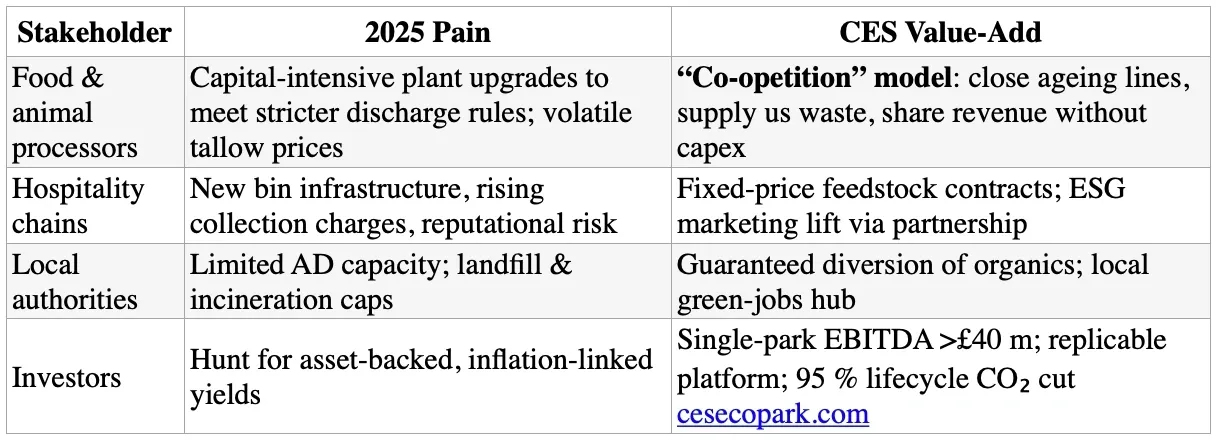
CESECO ‘Eco Parks’: a turnkey solution for industry pain points
Numbers that move the needle for capital partners
- £3–5 bn UK market: Valuing food & animal waste at conservative £150–250 t gate fees.
- Double-digit IRR: Even under base-case power and fertiliser prices, margin uplift from lower feedstock cost adds ~220 bp to the project IRR versus 2023 modelling.
- Pipeline ready: Sites in Northern England, Wales and the Midlands all within 30 km of industrial meat clusters, de-risking logistics.
With $100 m+ capex per park and modular duplication potential, early investors gain board-level influence in a multi-billion platform before scale re-rates valuations.
Social licence: job creation & regional growth
DEFRA estimates the new regime will create 21 k recycling jobs nationwide; each Ecology Park adds ~150 direct roles plus 300 in haulage, engineering and farming services. That’s levelling-up in action—critical for planning approvals and ministerial support.
Call to action: capacity reservations now open
The first three UK Ecology Parks move to financial close in Q4 2025. We’re allocating up to 60 % of initial processing capacity to long-term partners at launch pricing:
- Processors & renderers – lock in feedstock offtake and eliminate compliance risk.
- Bio-fuel refiners & fertiliser distributors – secure low-carbon molecules at scale.
- Institutional investors – access a shovel-ready asset class indexed to mandatory waste flows.
Secure your seat at the table before construction begins.
Message me directly or visit ceseco.org to download our data-room teaser and schedule a site tour.
