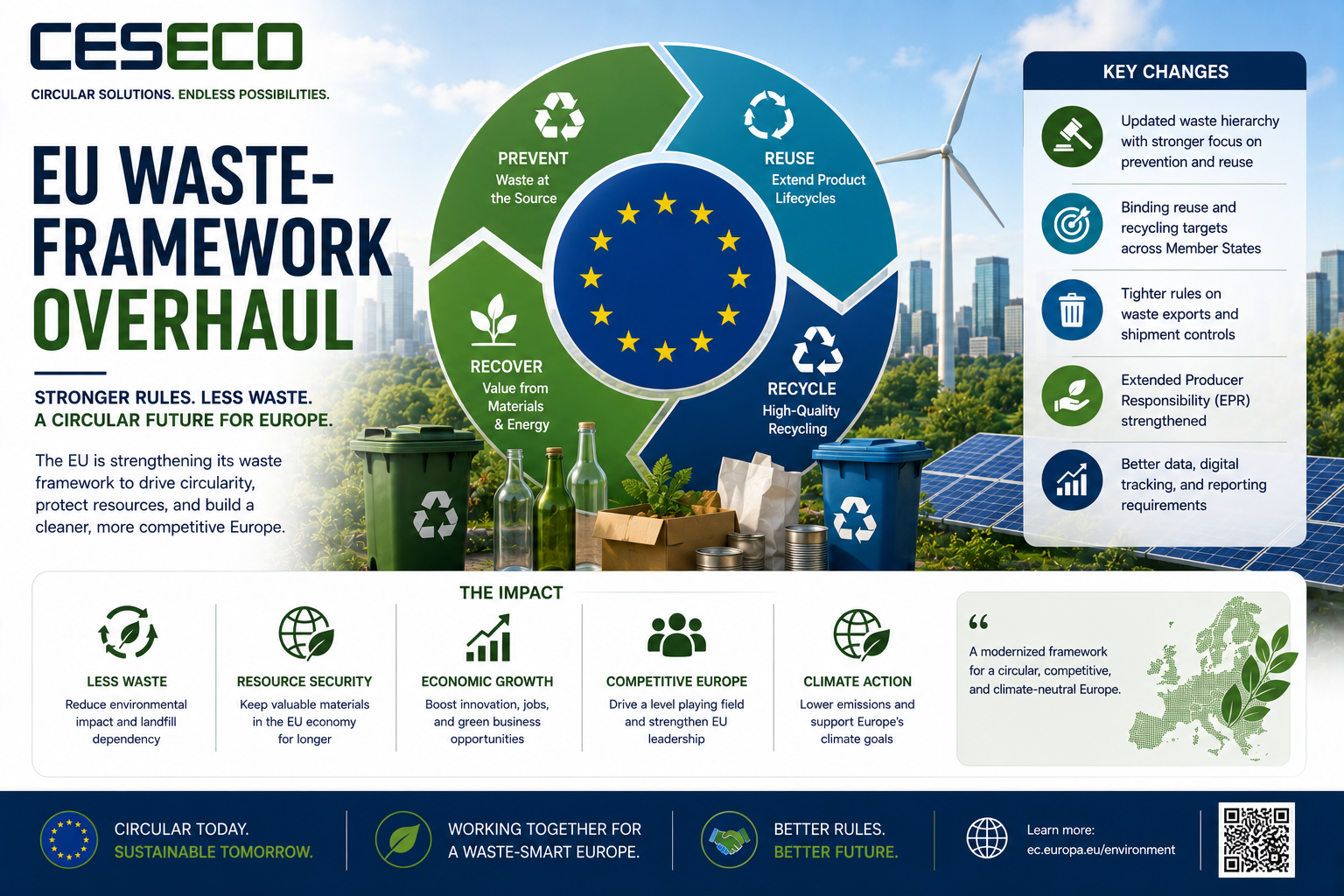
Why CESECO “Co-Opetition” Turns Regulation Into Profit—Fast
Brussels has just put a clock on food-waste inefficiency. On 19 February 2025 the Council and Parliament struck a provisional deal to revise the EU Waste-Framework Directive; the final vote is a formality. For the first time ever, every member state must put its shoulder behind legally binding food-waste-reduction targets that slash processing losses by 10 percent and cut retail-and-household waste by 30 percent per capita by 31 December 2030. Miss the mark and a country faces infringement proceedings, fines, and bruising headlines.
Behind the policy sits a vast, under-priced resource. Eurostat estimates 59 million tonnes of food are wasted across the bloc each year—roughly €132 billion of potential value literally going in the bin. Add the carbon footprint (about 250 million tonnes CO₂-e) and the political will to act is obvious. The new directive forces companies to measure, report and, crucially, do something with waste once it leaves the production line.
The Compliance Squeeze on Processors
- Mandatory measurement and disclosure
Any food company above SME size must install certified tracking systems and publish progress in its annual report. - Capex or closure
Retrofitting an ageing rendering or by-product line with ozone scrubbers, anaerobic pre-treatment and real-time monitoring typically costs £25–30 million for a 60 kt per-year plant. Many balance-sheets can’t take that punch. - Razor-thin margins
Food processing already operates on single-digit EBITDA. Layer in depreciation on new kit and the return on capital drops below the board’s hurdle rate—often below the cost of debt.
No wonder executives are hunting for a faster, cheaper route to compliance.
Enter CES Eco Parks: The Co-Opetition Shortcut
Instead of pouring cash into incremental upgrades, processors can partner with CESECO through our co-opetition model:
- Close expensive waste lines and free up floor space for core production.
- Send unavoidable by-products to the nearest CESECO Ecology Park under long-term supply contracts.
- Share upside from the premium outputs we create—renewable diesel lipids, nutrient-rich bio-fertiliser and baseload green electricity—while we shoulder the regulatory burden.
Everybody wins: processors turn a cost centre into a predictable revenue stream; CESECO locks in volume at scale; investors back a platform cushioned by mandatory demand; and the planet sees real emissions cuts.
How the Model De-Risks Investment
- Policy tightening – Legacy plants must retrofit every few years as limits ratchet tighter. CESECO designs to the best-available EU standards from day one and spreads future upgrade costs across an expanding fleet.
- Volume certainty – A stand-alone renderer lives or dies by a single slaughterhouse’s throughput. CESECO pools feedstock from dozens of partners, smoothing supply risk.
- Revenue diversity – Traditional plants rely on one low-margin product (tallow). CESECO monetises four streams: gate fees, biofuels, fertiliser and electricity.
- Valuation uplift – Old-school renderers trade at 6–8 × EBITDA. Circular-economy infrastructure platforms like ours commanded 12–16 × in 2024 transactions.
Numbers That Move Limited Partners
A single Eco Park processes 400 kt of feedstock a year, generates over £40 million of EBITDA, and returns an un-levered IRR of 12–14 percent at conservative price assumptions. Because gate-fee costs tend to fall when regulation floods the market with surplus waste, every one-percent drop widens margin by roughly £1.5 million—adding about 20 basis-points to IRR. Lifecycle analysis shows a 95 percent CO₂-e reduction versus landfill or incineration, so investors can log hard-to-argue ESG wins under the EU Taxonomy and forthcoming UK SDR rules.
Why UK Stakeholders Should Care
Brexit doesn’t insulate British exporters. If a UK meat processor wants shelf space in Paris, Madrid or Berlin, its environmental profile must match EU standards. Partnering early with CES future-proofs market access and generates the audit-ready data that UK disclosure frameworks now demand. Meanwhile, by funnelling continental volumes through British Eco Parks, we channel euro-denominated cash into UK regions that need private investment most—delivering green jobs and levelling-up credentials ministers love to champion.
Upcoming Catalysts
- Q4 2025 – Financial close on the first two UK Eco Parks removes construction risk.
- Q2 2026 – Framework supply memoranda signed with three EU protein majors secure ~70 percent of feedstock.
- Q3 2026 – Offtake agreements inked with two Sustainable Aviation Fuel refiners set a price floor for our bio-lipids.
- Q1 2027 – The revised EU directive enters force and national action plans kick in, steepening feedstock inflows and boosting margins.
Every milestone tightens our volume moat and supports a higher valuation.
Ready to Share the Upside?
We’re allocating up to 50 percent of phase-one capacity to strategic supply partners and offtakers at launch pricing. Equity slots in the current construction round start at £20 million, with warrants for future EU roll-outs.
🔗 Request dataroom access or a virtual site tour at cesecopark.com/investors, or drop me a DM.
