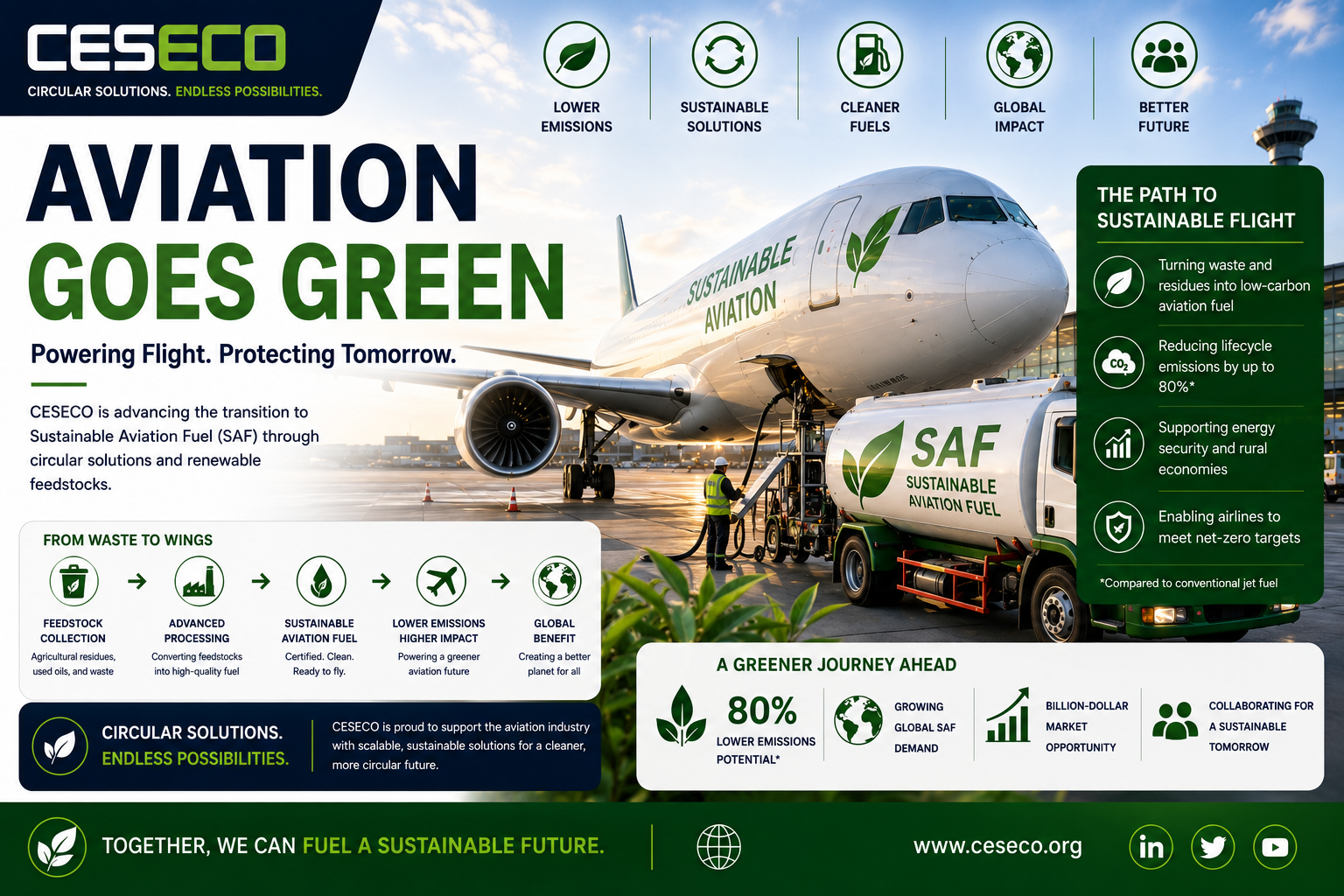
Why the UK SAF Mandate Makes CESECO Bio-Fats the Fastest Route to Net-Zero Flight
The UK just rewrote the flight plan for every airline that takes off from Heathrow, Gatwick or Manchester. From 1 January 2025, jet-fuel suppliers must blend 2 percent sustainable aviation fuel (SAF) into every tonne of kerosene they sell. That quota rises every year to hit 10 percent—about 1.2 million tonnes—by 2030 and 22 percent by 2040. The policy is locked in through the government’s Jet Zero Strategy and sits in secondary legislation under the Renewable Transport Fuel Obligation. gov.ukgov.uk
A feed-stock crunch is coming
- UK airlines burned roughly 11–12 million tonnes of jet fuel in 2023 as traffic rebounded toward pre-pandemic levels. assets.publishing.service.gov.uk
- Meeting 10 percent SAF therefore means replacing one jumbo-tank’s worth—more than a million tonnes—of fossil kerosene every year within the next five years.
- Yet global SAF output in 2024 was only 600 000 tonnes, and 90 percent of the UK’s share came from imported used-cooking-oil (UCO), mostly from China. thetimes.co.uk
The maths is brutal: demand is about to outstrip the world’s entire current supply by a factor of two—just for the UK.
HEFA wins the early race—and CESECO owns the feed-stock
The mandate allows hydro-processed esters and fatty acids (HEFA) to satisfy up to 100 percent of the quota in 2025-26, falling to 71 percent in 2030 as more advanced Power-to-Liquid options scale. gov.uk
HEFA is made from lipid streams: used cooking oil, tallow and—critically—purified animal fats. That happens to be CESECOs’ signature product:
- Each park converts ~320 000 tonnes of animal by-products into clean bio-fats, bio-fertiliser and baseload renewable power.
- A single site can deliver 30-60 000 tonnes of HEFA-grade feed-stock annually—almost a third of the UK’s entire 2025 SAF obligation.
- Because we capture material the food chain can’t reuse, our carbon intensity is among the lowest on the market, giving airlines the biggest lifecycle CO₂ savings per litre.
What this means for investors
Lock-in long-dated offtake contracts. Airlines and fuel blenders will pay a premium for secure, domestic molecules rather than rely on volatile import markets. Early-stage equity buys into a business model with:
- Multi-stream revenues: gate fees from waste suppliers, sales of bio-fats into SAF, power-purchase agreements for electricity, and fertiliser offtake.
- Inflation linkage: both gate fees and SAF certificates index to CPI and carbon prices, providing a hedge against macro shocks.
- Double-digit un-levered IRRs in the 12–14 percent range, even before upside from widening SAF spreads as the quota tightens.
Explosive demand growth baked in. Moving from 2 percent to 10 percent SAF within five years represents a five-fold volume ramp. Every percentage-point blend uplift adds roughly 115 000 tonnes of extra demand—effectively pre-sold capacity for scalable suppliers like CESECO.
Policy insulation on both sides of the Atlantic. While the EU’s ReFuelEU regulation targets 6 percent SAF by 2030, the UK leaps to 10 percent, creating a premium market that rewards first movers. Airlines cannot “fly around” the rule; the obligation is placed on fuel suppliers at the point of uplift.
What this means for airlines and fuel suppliers
- Certainty: HEFA meets ASTM D7566 and is already flying today, so no technology-risk discount.
- Carbon maths that works: CESECO bio-fats can cut lifecycle emissions by upto 90 percent versus fossil kerosene—enough to keep carriers on a Science Based Targets initiative-aligned trajectory.
- UK supply security: Domestic production de-risks geopolitical shocks and import bottlenecks.
Why CESECO is the de-risked partner
- Feed-stock moat – Mandatory food-waste separation (England, 2025) and EU waste-cut targets flood us with low-cost input streams.
- Regulatory head start – Our plants are designed to Best-Available Technique standards for Animal-By-Product Category 1 & 2 processing—future-proofed against tightening rules.
- Scale now, replicate later – The first three UK parks will collectively supply up to 250 000 tonnes of HEFA feed-stock a year; the blueprint can be cloned across Europe, North America and APAC.
Upcoming milestones
- Q4 2025: Financial close on Park #1 and offtake term-sheets signed with two fuel majors.
- Q2 2026: First construction steel in the ground; airline pre-purchase agreements executed.
- H1 2027: Commissioning and delivery of inaugural bio-fat cargo—just as the SAF quota climbs past 4 percent.
Every milestone tightens our capacity and lifts the comparable transaction multiple.
